Can off-site domestic parking solve our housing crisis and become our greatest community asset?
Residential Design for the Suburban Realm
The way we live is changing. As technologies and populations boom, our cities are swelling, infrastructure is buckling, and we are wondering why we can’t feel or see any progress towards fixing it. New generations are facing challenges not experienced by their predecessors, resulting in a housing crisis still facing an uncertain future. One thing remains clear; addressing this crisis requires innovation and creative thinking. As governments scramble to provide more dwellings with speed and cost front of mind, challenges in planning regulations, existing community opposition, and the preservation of the character and history of cities, suburbs and towns, can seemingly curtail advancements. Yet if we are courageous, history teaches us that this can provide opportunity to reinvent the wheel slightly, with promising results. So, what might the proposed densification of Canberra mean for our traditional suburban ideals of space, community and nature, and how might we be able to pivot into new unchartered territory to address it?
The ACT Government recently released a draft of the Missing Middle Housing Design Guide, a significant step in addressing the ongoing housing affordability and supply crisis. The Design Guide and the proposed amendments to the Territory Plan, aim to densify inner-city suburbs, with a target to deliver 70% of all future housing on existing residential blocks. The commitment to developing this guide demonstrates a level of creative thinking in offering a path that involves integration into existing communities, rather than extending an endless suburban sprawl. It affords opportunity to keep Canberra’s footprint tight, connected, and with a thoughtful urban realm, providing more equality and access to amenity for all.
The proposal is a pivotal moment in reshaping Canberra’s suburban identity; from single detached homes on quarter acre blocks in prime inner-city suburbs, to medium-density developments that will at least double or triple the number of dwellings within that area.
However, by aiming to substantially densify inner-city suburbs, the proposal also risks undermining key aspects of suburban form that contribute to shaping healthy communities. These include safe pedestrian infrastructure for walkable neighbourhoods, spaces for building social cohesion and trust, and integration of natural environments that mitigate urban heat and support overall well-being through their presence. The densification risks traffic congestion, loss of domestic areas for parking amenities, and compromised green space for roads and transport access.
There is hope in addressing these challenges within suburban environments. Emerging technologies in mobility and transport are presenting significant opportunities to rethink how we design and manage our urban and suburban spaces. Many of our residential street networks are still based on post-war models of the 1950s, with only minor adjustments made over time to accommodate a growing population and an increase in the size of private vehicles. The future of private and public transport has the potential to fundamentally change how we approach urban mobility, private car ownership, and vehicle storage, and within the context of inner suburban densification, to allow us to reclaim spaces both on and off sites. Over the next 50 years, we are likely to see technological advancements that will make the past century look prehistoric by comparison. For architects and urban planners, this shift presents a wealth of creative opportunities. As our cities and suburbs become denser, we must explore alternative models for managing private and public transportation.
Densification of our cities doesn’t have to compromise what we love about Canberra; access to nature, to driving infrastructure, and to conveniences we value, that help our busy lives function.
Parking currently takes up a significant amount of space on established blocks. A quick survey of a typical missing-middle dwelling shows that the living space (often an open-plan living and dining) averages from 15 to 20 square meters, and in contrast, a private garage can be twice that, ranging from 24 to 40 square. That means that the space reserved for the storage of your car often surpasses the space where your family eats, talks, relaxes, and connects.
Advancements in vehicle automation, shared mobility, and driverless technology offer an opportunity to reclaim this underutilised space without compromising the convenience of private transport. For example, centralised parking facilities that take your vehicle off-site, but within close walking distance, can be designed to be a community asset, affording the potential to enhance land use efficiency, and adding to community interaction and infrastructure. This would significantly reduce roads and driveways, shifting the focus of suburb planning to greenspace, benefiting people and nature. The concept can be easily executed today with our current car usage, providing immediate household and community benefit, but it also prepares us strategically to maximise forthcoming technologies in which cars will be autonomous, accessed and recalled via a personal smartphone, currently being successfully trialed overseas.
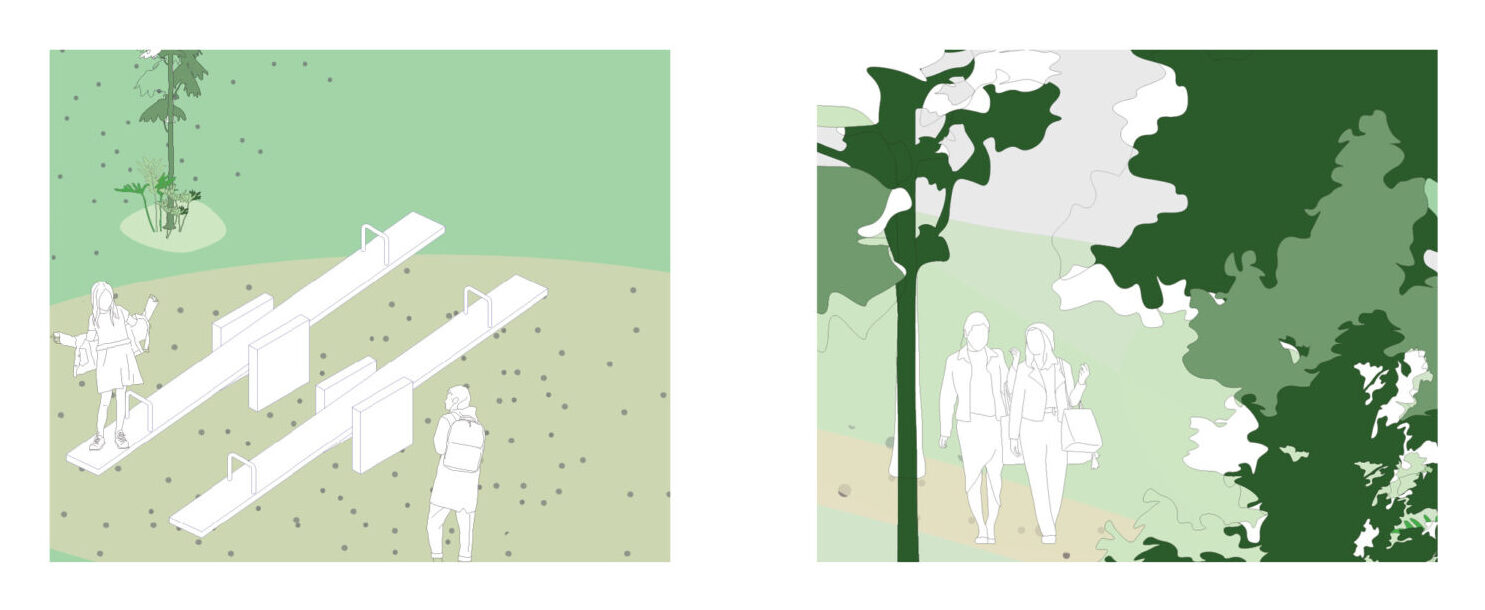
The concept of centralised domestic car parks (a multi-level car park, under or above ground) presents a plethora of potential design-led directions. Designed to serve individual blocks within a zone of influence, the parking structures have the potential to provide additional amenity for the community, through becoming mixed-use developments with integrated community functions. A successful example of this is Park ‘n’ Play by Ja Ja Architects, located in Copenhagen, Denmark. Designed to take a monofunctional building and make it multifunctional, the addition of a rooftop playground, as well as a green façade with integrated artwork, creates an inviting space for the community to use. There are multiple options for how these carparks can be used beyond vehicle storage. They can become flexible spaces for community use, including multifunctional indoor and outdoor areas for celebrations, markets, workshops, retail, gardens, food, exercise, and childcare. Imagine picking the kids up from school, parking the car, grabbing a coffee and heading to a safe rooftop play area, where everyone can connect with neighbours and friends. Amenities such as charging stations, bicycle repair shops, and shared interest spaces, build connections and develop activation throughout these suburban realms, setting up opportunities for social cohesion. These carparks can even be designed to be future proofed for adaptive reuse, either transforming into residential or commercial spaces, or extending vertically to include more properties. Shared centralised infrastructure such as solar energy generation, rainwater collection for use on site and storage can also be included.
In addressing current and future challenges, we can look to both historical and global precedents to direct our path.
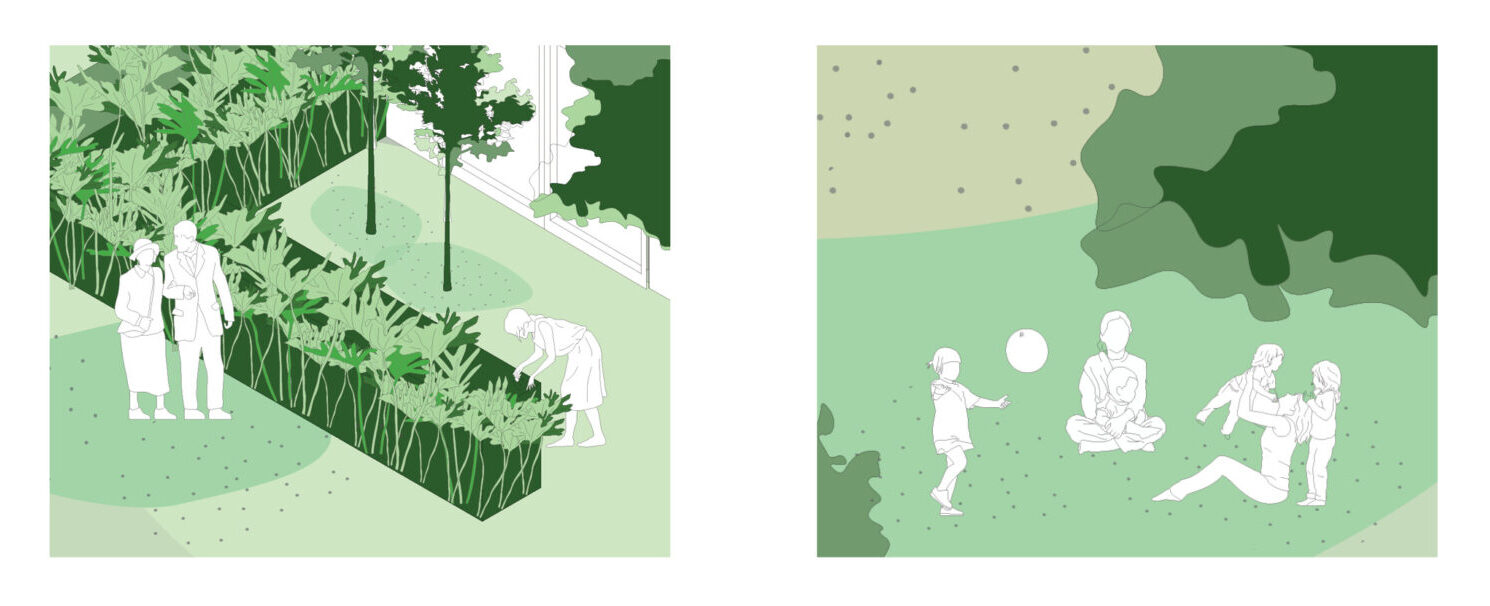
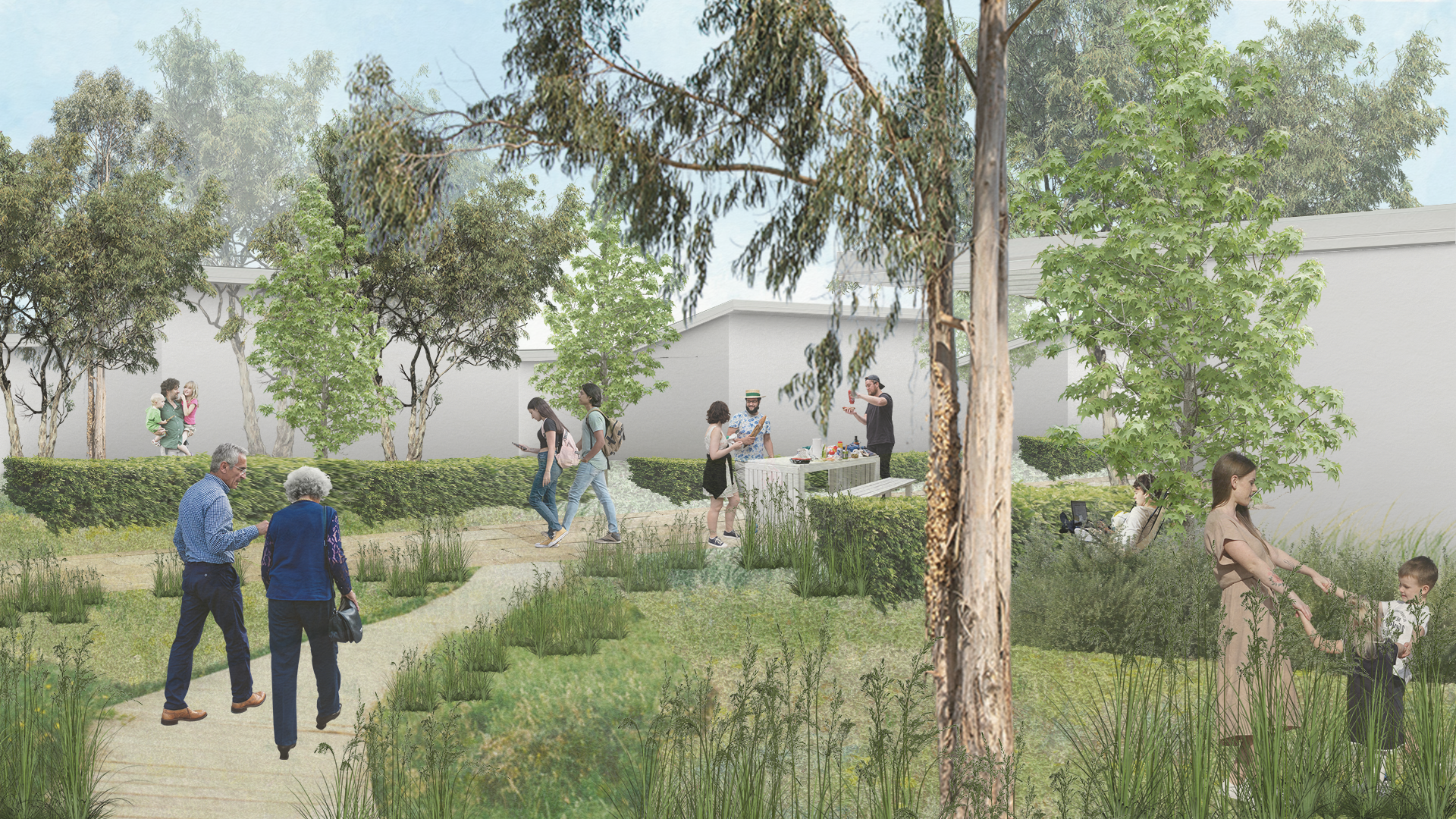
With clear benefit to the community, how does this affect the individual house dweller? Many of these parking provisions are designed around convenience, but that doesn’t have to be compromised. Offsite carparking would be within walkable distances such as those currently implemented in apartment and townhouse complexes, with access for all. Service roads and drop-off points would allow domestic and city service vehicles access to the dwellings without compromising the expanded green spaces. By removing the need for on-site domestic vehicle parking, in the context of missing middle developments, we could reclaim between 10% and 20% of the site area. Within the context of a suburb, this is hugely significant. This additional space could be used for additional dwellings on site and subletting, more space for internal and external living areas, increased private garden space for food gardens and family activities, more public outdoor space for community building, or extra areas for the things we love – canoes, bicycles, workshops, cubby houses, the list goes on. Within the shared parking facility, opportunities to own more or less parking spaces, as circumstances change allow people flexibility, particularly significant to small business owners or sole traders who often struggle to find additional parking in suburban environments near their homes, and those whose household members change over time.
The opportunities are endless, but essentially, the focus is on us and our well-being, not our cars. These innovations not only improve the functionality of individual housing blocks by relocating domestic vehicle storage off site but also offer a broader benefit: shifting the focus away from cars and infrastructure, and towards more vibrant, community-oriented, human-scale environments.
We love our cities for what they represent and offer: community, connection, convenience, history, place, and belonging. With the rapid evolution of technology, now is the time to reimagine the suburban model in our changing cities, and to evolve their fundamental ideals rather than lose them.